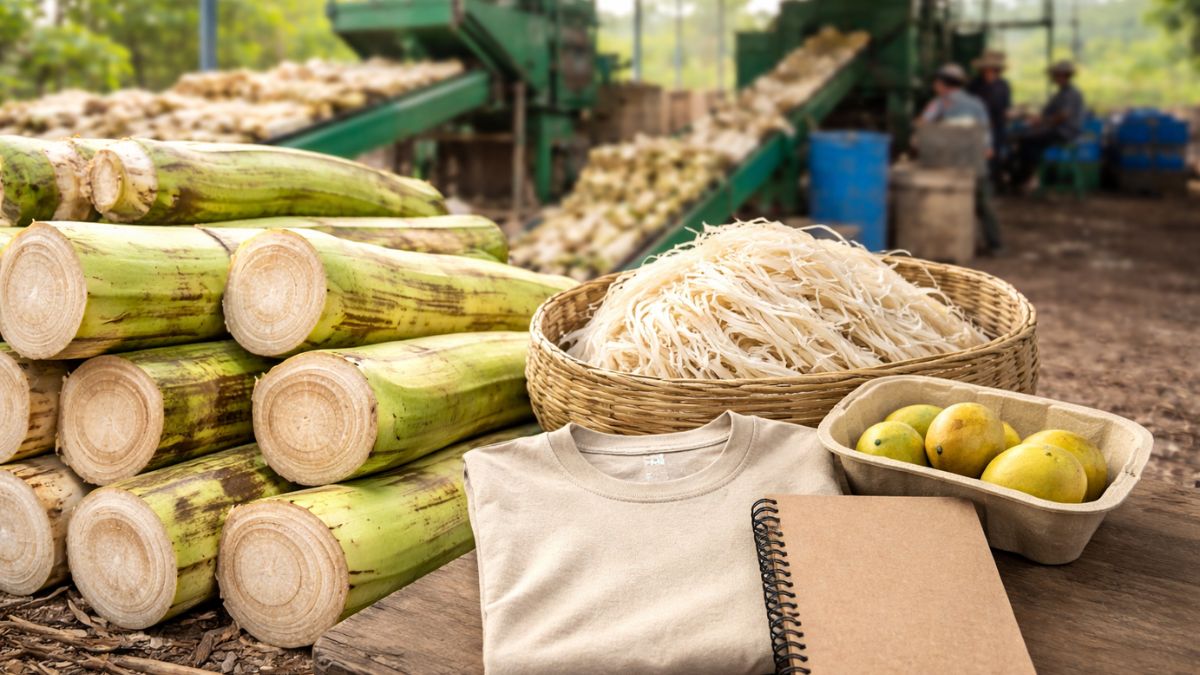
Banana cultivation generates large volumes of biomass beyond the fruit that reaches consumers. Among these residues, the pseudostem stands out due to its size and composition. Traditionally treated as waste or left in the field, it is now being reconsidered as a potential raw material for several industries. Advances in mechanical extraction and controlled processing are enabling its transformation into fibers for textiles, paper, and composite materials.
This shift reflects a broader effort to improve resource efficiency in agriculture. Studies indicate that only a small fraction of the banana plant is used as food, while the rest remains underutilized. In some farming systems, residues can reach approximately 220 tons per hectare. At a global scale, this translates into tens of millions of tons of biomass each year, particularly in major producing countries such as Brazil.
Waste

The banana pseudostem is characterized by high moisture content and bulk, which complicates storage and transport. As a result, it has often been left to decompose or has been removed without further use. However, its internal structure contains cellulose-rich fibers with notable mechanical properties.
Recognizing this potential, researchers and companies are looking into ways to integrate pseudostem utilization into existing agricultural systems. The aim is not only to reduce waste but also to create additional value streams for farmers and processors.
Fiber
Banana pseudostem fibers are composed primarily of cellulose, hemicellulose, and lignin. Their tensile strength has attracted attention, as it can exceed that of commonly used natural fibers such as jute and sisal.

A comparison of tensile strength is shown below:
| Fiber Type | Tensile Strength (MPa) |
|---|---|
| Banana Fiber | ~570 MPa |
| Jute | 400-500 MPa |
| Sisal | 350-450 MPa |
These properties make banana fibers suitable for applications requiring durability and flexibility. They can be processed into yarns for textiles or used as reinforcement in composite materials.
Process
The conversion of pseudostems into usable fiber begins near the site of cultivation. Due to their weight and high water content, transporting raw stems over long distances is not practical. Processing facilities are therefore typically located close to farms.

The main extraction method is mechanical decortication. In this process, rollers and blades separate fibers from the surrounding pulp. This approach avoids the use of harsh chemicals and is considered more suitable for industrial scaling.
Following extraction, the fibers undergo several steps:
- Washing to remove residual pulp and impurities
- Drying under controlled conditions to stabilize moisture
- Alignment and preparation for spinning or other applications
Drying is particularly important. Research shows that temperature and airflow can influence fiber strength, color, and durability. As a result, many facilities use a combination of air drying and controlled heating to ensure consistent quality.
Industry
The use of banana fiber has moved beyond small-scale craft production. Industrial initiatives are now focusing on building structured supply chains with defined standards and traceability.
In Brazil, projects supported by institutions such as SENAI have demonstrated the feasibility of producing banana-based textiles on a larger scale. One initiative, known as Banana Textil, has developed fabrics suitable for industrial weaving and has received recognition in international innovation forums.
This transition from artisanal to industrial production depends on consistent raw material quality, efficient logistics, and reliable processing methods.
Products
Banana pseudostem fiber can be used in several sectors:
- Textiles: blended yarns for clothing and household fabrics
- Paper: alternative pulp for paper products
- Packaging: molded trays and boards for food applications
- Composites: reinforcement in bio-based materials
In packaging, experimental studies have shown that banana fiber boards can match or exceed the mechanical performance of recycled paper pulp in certain conditions. However, higher water absorption remains a limitation that requires further development.
Byproducts
The fiber extraction process produces additional outputs, including pulp and liquid residues. These materials can be repurposed rather than discarded.
Potential uses include:
- Organic fertilizers
- Compost for soil improvement
- Biogas production
- Liquid nutrient solutions
Utilizing these byproducts is important for both environmental and economic reasons. If not managed properly, residual biomass can lead to odor issues and water contamination.
Challenges
Despite its potential, the use of banana pseudostem fiber faces several challenges:
- Water consumption during washing processes
- Need for efficient wastewater treatment systems
- Training requirements for farmers and workers
- Logistics related to collection and transport
Addressing these factors is necessary to ensure that the process remains sustainable and economically viable.
Future
The development of banana pseudostem fiber reflects a broader trend toward circular resource use in agriculture and industry. By converting residues into valuable inputs, it is possible to reduce waste and diversify income sources.
While banana fiber is unlikely to replace all conventional materials, it offers a complementary option for sectors seeking renewable and biodegradable alternatives. Continued research and investment will determine how widely it can be adopted.
In practical terms, the approach is straightforward. Instead of treating banana pseudostems as waste, they can be processed into useful products and reintegrated into economic systems. This model aligns with efforts to improve sustainability without requiring entirely new resources.
FAQs
What is banana pseudostem?
The trunk-like structure of the banana plant.
Is banana fiber durable?
Yes, it has high tensile strength.
Where is it used?
In textiles, paper, and packaging.
Is processing eco-friendly?
Mostly, but water use must be managed.
Can farmers benefit from it?
Yes, it adds value to agricultural waste.